

ISO 9001 is the world’s most widely adopted standard for quality management. It describes how organisations should manage, document and improve processes to ensure consistent delivery and continual improvement.
In practice, quality is about delivering products and services that meet agreed requirements and expectations — consistently over time. When expectations exceed experience, dissatisfaction arises regardless of what is “believed” internally. Customer satisfaction, stakeholder requirements and the ability to improve systematically therefore become central elements of a certifiable quality management system.
Certain QMS has been developed to operationalise this thinking. The system brings together the key tools for quality management on a single platform and gives organisations a structured way to establish, use and maintain a quality management system in line with ISO 9001.
Below, we show how the requirements of ISO 9001 are supported by the functionality of Certain QMS.
From standard to practical management
ISO 9001 is built on a process-based approach and the PDCA cycle (Plan–Do–Check–Act). In practice, this means describing how the organisation works, planning and carrying out activities, evaluating results and making improvements in small, continuous steps. A quality management system is never ‘finished’ — it is maintained and improved in step with changes in requirements, risk and expectations.
Certain QMS is structured around the same logic, with modules for processes, documents, risk, non-conformities, planners, checklists and compliance registers. The interplay makes it easier to document the connection between requirements, processes, responsibilities and follow-up — which is often precisely what auditors look for.
Chapter 4: Context and processes
ISO 9001 requires the organisation to understand its context, identify stakeholders and establish the necessary processes for quality management. In practice, this means having an overview of internal factors (culture, competence, technology) and external factors (regulations, market and operating conditions), and assessing what genuinely affects the ability to deliver. For many organisations, consideration of climate- and weather-related factors is also relevant, as these can affect operations, delivery capability and risk.
Process management module
The organisation’s core and support processes are modelled and organised within the system, making the relationship between processes clear and accessible to the organisation. This provides a shared ‘map’ of how value creation and management fit together, and reduces the risk of practice becoming dependent on specific individuals. At the point of certification, it is often an advantage that process descriptions are practical and recognisable to those who actually carry out the work.
Document management module
Top-level governing documents such as stakeholder analyses, scope, quality manuals and principles for process management are established as version-controlled documents. This provides an audit-ready history and makes it easier to demonstrate that the system has been maintained over time — not just ‘created once’.
The document management module can also be used to establish standardised document structures and content templates, ensuring a consistent format for key governing documents. This enables faster setup and more uniform practice across departments.
Chapter 5: Leadership
The standard places requirements on management commitment, quality policy, responsibility and authority. In practice, this means that top management must own the system, set direction and ensure that governance actually takes place — not merely that documents exist.
Document management module
Quality policy, strategic guidelines and top-level responsibility descriptions are established as controlled documents with version management. This makes it easier to ensure that policy provides clear direction, and that it is more long-term than individual objectives that are often adjusted annually.
The document management module can also be used to consolidate and structure documentation relating to the management review, such as terms of reference, standing agenda items and decision-making material. This supports more consistent reviews over time and makes it easier to demonstrate that the requirements of the standard have been met.
Roles and access in the system
In Certain QMS, roles and access are assigned directly in the administration interface, so that responsibility and authority are also reflected in the system’s workflow. When responsibility is delegated, it is important that the role configuration actually enables tasks to be completed and followed up. This improves compliance and makes quality work more robust in the event of absence, turnover or organisational change.
Planner
Management reviews, internal milestones and other governance activities are created as activities with tasks, responsible parties and deadlines, visualised in the annual planner. This supports the requirement for planned follow-up and documentation of decisions and actions. It also makes it easier to consolidate relevant decision-making material — such as status on objectives, non-conformities, trends and resource needs — and to ensure that follow-up actually takes place.

Chapter 6: Planning
ISO 9001 requires the organisation to identify risks and opportunities, plan actions and manage changes in a controlled manner. The standard also expects quality objectives to be measurable, with clarity on what is to be measured, who is responsible for follow-up and how the effect is evaluated.
Risk management module
The organisation can identify, analyse and evaluate risks that affect the achievement of objectives and process performance, with actions assigned to responsible parties and followed up. This makes it easier to work in a risk-based way in practice — not just as an annual exercise. Actions can be integrated into operations and improvement activities, and provide traceability on what has been done and why.
Compliance register
In the administration interface, compliance registers can be established in which ISO 9001 requirements are recorded as individual compliance obligations. Requirements can be linked to relevant documents, processes and checklists, as well as to non-conformity categories, risk events from risk analyses and external links. In addition, requirements can be assigned responsible parties and review intervals.
This provides clear traceability between ‘requirements’ and ‘how we comply’, and makes compliance verification more systematic and less dependent on specific individuals.
Chapter 7: Support
The standard requires controlled documentation, accessible information and support for implementation. In practice, this means ensuring that employees have the right foundations, the right competence and access to up-to-date practices.
Document management module
Governing documents, procedures and work instructions are stored as version-controlled documentation with access management and full history. This makes it easier to demonstrate that information has been maintained and that employees are working in accordance with current requirements. The documentation can also be used as evidence during audits and internal follow-up.
Checklists
Checklists are used to support consistent execution and document compliance where it is important that ‘things are done the same way’. They can be linked to processes and compliance requirements, and contribute to stable delivery quality — particularly in operational environments with variation, shift work or many people involved.
SharePoint integration
Employees can carry out key quality activities directly in SharePoint, lowering the threshold for use and strengthening adoption. When quality work is accessible within everyday working environments, it also becomes easier to build awareness over time — not least for new employees. Traceability and documentation are maintained in the specialist system throughout.

Chapter 8: Operations
ISO 9001 places requirements on the planning and control of operational activities, so that products and services are delivered in line with defined requirements.
Process management module
Operational processes are described and made accessible, typically linked to relevant documents and checklists. This provides clarity on how work should be carried out and reduces the risk of delivery varying between individuals or teams. The processes become a practical reference tool, not just ‘diagrams for certification’.
Checklists and non-conformity management module
Execution is supported by checklists, and non-conformities are recorded when something does not go as planned. Non-conformities are handled systematically, making it clear what was done immediately and what needs to be followed up further. This strengthens control over delivery and reduces the risk of recurrence.
Chapter 9: Performance evaluation
The standard requires monitoring, internal audits and management review, so that the organisation can assess whether the system is working and whether it is delivering the desired effect.
Planner
Internal audits, reviews and management reviews are planned as activities with fixed intervals, responsible parties and documented completion. This provides structure to follow-up work and makes it easier to take a risk-based approach to audits and evaluations. The history of completed activities helps to document continuity over time, including at recertification.
Non-conformity management module
Non-conformities are used as a data source for analysing trends, recurrences and areas for improvement. This supports evidence-based decision-making and makes management assessments more fact-based. Combined with customer feedback — such as complaints, meetings, surveys and ongoing dialogue — this provides a comprehensive picture of the system’s impact.
History and traceability
The completion of activities and non-conformity handling are recorded with responsibility and status, providing a consolidated decision-making and follow-up trail over time. This makes it easier to verify ‘what was done’ and ‘what was decided’, and contributes to audit-ready documentation. Traceability is often crucial for demonstrating maturity and stability in the quality management system.
Chapter 10: Improvement
ISO 9001 requires non-conformity management, corrective actions and continual improvement. The aim is to reduce errors, strengthen processes and increase customer satisfaction over time.
Non-conformities and actions
Non-conformities are recorded, assessed and followed up with actions, responsible parties and deadlines. It is useful to distinguish between immediate actions (correction) and full non-conformity handling with root cause analysis and corrective actions, so that the situation is both addressed and recurrence prevented. A simple and systematic approach to root cause analysis — for example, ‘5 Whys’ — makes actions more targeted.
Continual improvement in practice
The interplay between risk, planning, operations, non-conformities and management follow-up creates a continual improvement loop. When information is gathered on the same platform, it becomes easier to extract insights and translate them into concrete changes to processes, documentation and practice. This is often what distinguishes a certifiable system from one that is merely documented.
A platform for certification and further standardisation
Certain QMS gives organisations a framework for establishing a quality management system in line with ISO 9001, with structured documentation, process-based management, risk-based planning and traceable follow-up. Once the ISO 9001 structure is in place, much of the foundation is also laid for further work with other management standards, such as ISO 27001 and ISO 14001.
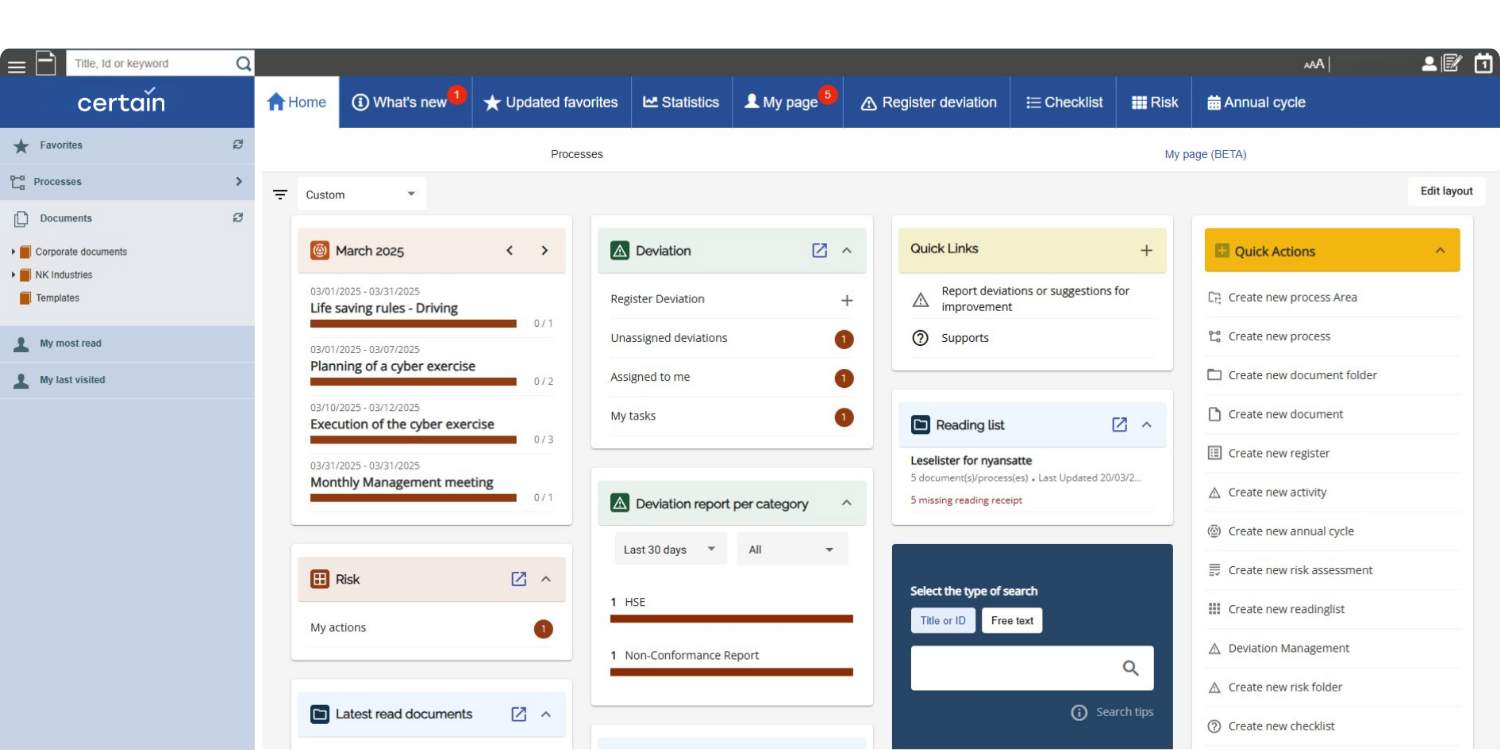
Example of the Certain QMS homepage.
From intention to certification
ISO 9001 is about good habits for management and improvement — and about making it easy to do the right thing. Certain QMS supports this by bringing together processes, documentation, follow-up and improvement in one cohesive solution with clear roles, planned activities and traceable history.
The result is a quality management system that not only satisfies certification requirements, but also delivers real value in the organisation’s day-to-day operations.

Marte Sunde
Business Consultant