

When multiple organisations need to collaborate on quality management, a shared challenge frequently arises: how to share structure, requirements and best practice whilst allowing each organisation to adapt the system to its own operations. Whether it involves a group with established HSEQ functions or collaboration between independent organisations, the goal is to strike the right balance between standardisation and local control.
Certain QMS has been developed precisely for this purpose, with a solution that makes it possible to build on a shared quality framework whilst each organisation retains ownership of its own quality management system.
When multiple organisations need to benefit from the same quality framework
In groups and larger organisations with dedicated HSEQ resources, established structures and extensive documentation in the management system typically already exist. The challenge is often to ensure that this content is accessible and straightforward to adopt across all parts of the organisation — across departments and business units.
In alliances and industry collaborations, the starting point is often different. Here, the collaboration typically consists of organisations with limited capacity to develop and maintain a fully functioning quality management system on their own. The need is therefore access to ready-made structures, templates and recommended working methods that can serve as a starting point within their own organisation.
Both situations require a solution that enables quality content to be shared in a structured way, whilst allowing each organisation to adapt the system to its own circumstances and responsibilities.
Support for a shared quality framework with local adaptations
Certain QMS has been developed to support both of these scenarios. The solution can be used both in organisations where shared quality frameworks are defined centrally, and in collaborations where independent organisations have agreed to develop and use shared structures, templates and working methods for quality management.
One master solution – separate quality management systems
A central “master solution” is established, functioning as a shared quality framework with structure, templates and a recommended configuration for the quality management system. The content of the master solution is developed and maintained by a central HSEQ function or a working group with representatives from the various organisations.
Each company receives its own installation of Certain QMS, based on and integrated with the master solution. This provides a shared structure and content, whilst each company has its own users, its own data and full ownership of its own quality work.
In this way, multiple organisations can work within the same quality framework, whilst the system can be adapted to local operations.
How it works
The master solution in Certain QMS can be configured and adapted at several levels, functioning both as a template for system configuration and as a shared starting point for governing documents. These two elements are handled somewhat differently.
Master solution as a template for system structure and modules
Certain QMS consists of several modules for quality management. The master solution can contain ready-made configurations, structures and templates, for example for:
- Document structure and folder structure
- Processes and workflows
- Non-conformity handling and categorisation
- Risk analyses and risk templates
- Checklists
- Annual planners and scheduled activities
When a local installation is created, this configuration is copied from the master solution and used as the starting point for the organisation’s own quality management system.
Once the local installation has been established, the organisation is free to:
- Modify structures
- Adjust processes
- Add or remove content
- Adapt the system to its own operations
If improvements or changes are subsequently made to the master configuration, these can be transferred to local installations as required — but this is carried out as a managed update, initiated by the system administrator.
This gives the organisation full control over its own quality management system, whilst retaining the option to adopt improvements developed centrally.
Governing documents: continuous synchronisation and local extension
For governing documents, the solution is more dynamic — precisely because this is content that often needs to be kept up to date across organisations.
Documents managed in the master solution are shared with local installations through continuous synchronisation. The system checks at regular intervals whether there are new or revised documents to be made available locally.
Examples of governing documents often managed centrally:
- Top-level policies for quality, HSE and internal control
- Shared procedures for non-conformity handling and improvement work
- Guidelines for risk assessment and use of risk matrices
- Requirements for documentation, traceability and archiving
- Emergency procedures and notification routines
- Routines for training and competence assurance
- Audit programmes and methodology for internal audits
- Guidelines for supplier follow-up and procurement
- Templates for work instructions and checklists
When documentation is updated centrally:
- Local users are notified by email
- They are informed which documents are new or changed
- It can be assessed whether local adaptations need to be updated
At the same time, each organisation is free to add its own local documents that are not linked to the master solution.
How local extensions work in governing documents
For documents originating from the master, a simple and clear model is used for local adaptation:
The main body of the document is locked for editing, but a dedicated field is available for local clarifications and additions. When this is used, the document is referred to as an extended document.
In this way, the following are preserved:
- Shared wording and requirements in the main document
- Whilst local practice can be clearly and correctly documented
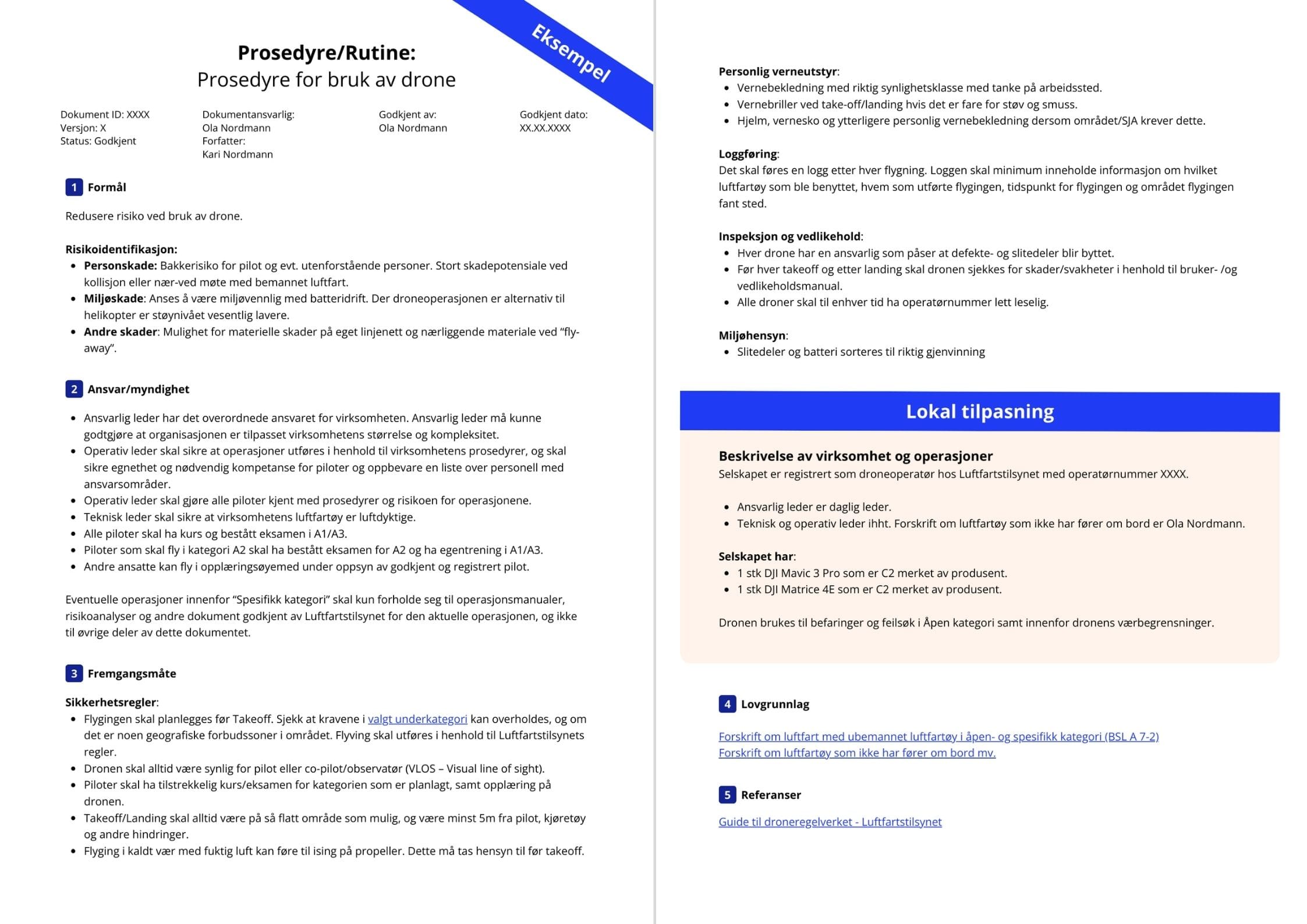
Example of a governing document where the main content is managed centrally, whilst local clarifications are added in a dedicated field as part of an extended document.
Two purposes – one solution
The master solution in Certain QMS thus supports two distinct needs:
- as a template for system configuration and quality structure, where local installations are built on a shared foundation
- and as a shared source for governing documents, with ongoing updates and clear handling of local adaptations
This provides both flexibility in system use and confidence that shared requirements and procedures can genuinely be kept up to date across organisations.

Mirjam Meling
Marketing & Communications Manager