
What is AI governance – and why do organisations need it?

What is AI governance – and why do organisations need it?

AI governance

Artificial intelligence is becoming a natural part of working life. Employees use ChatGPT for content production, developers use AI assistants for programming, and a growing number of IT systems are incorporating built-in AI features.

For many organisations, this is happening faster than the establishment of guidelines, accountability and control mechanisms. The result is that AI is being adopted without management necessarily knowing how, where or for what purposes the technology is being used.

“AI governance” has become one of the most important terms in artificial intelligence. In simple terms, it concerns how organisations manage, control and follow up on their use of AI.

What does "governance" actually mean?

Governance is a term used in areas such as quality, information security, data protection and corporate management. It describes how an organisation establishes accountability, rules, processes and control mechanisms to ensure that an area is managed in the desired way.

When we talk about AI governance, it is therefore not about the technology itself, but about how the organisation manages its use of artificial intelligence.

What does AI governance mean?

AI governance is about establishing rules, accountability, processes and control mechanisms for how artificial intelligence is used within the organisation.

The goal is not to limit innovation or prevent the use of AI. On the contrary, AI governance is about facilitating safe, effective and responsible use of the technology.

An AI governance programme should help the organisation to:

  • use AI in a controlled manner
  • manage risks associated with AI
  • meet relevant legal requirements
  • protect information and personal data
  • ensure quality and reliability in AI-based processes
  • document how AI is used and followed up

In short, AI governance is about managing artificial intelligence in the same way that organisations already manage quality, information security and data protection.

Why has AI governance become important?

In just a few years, AI has moved from being a niche technology to a tool used by employees across almost every function.

Leaders use AI for analysis and decision support. Marketing teams use AI for content production. HR uses AI in recruitment and competence development. Developers use AI for code generation and testing.

At the same time, both the risks and the requirements for control are increasing.

The need for AI governance is growing rapidly, driven in part by the following.

Generative AI is already in use within the organisation

Even where the organisation has not introduced its own AI solutions, employees often use AI tools on their own initiative. This can create challenges relating to security, quality and compliance.

AI influences decisions

When AI is used for decision support or to automate processes, it becomes important to understand how results are generated and what limitations the technology has.

Data protection and information security

AI systems often process large volumes of data. Without clear guidelines, sensitive information can be shared with external services or used in ways that are not in line with the organisation’s requirements.

New regulatory requirements

EU AI Act introduces new requirements for organisations that develop, supply or use AI systems. Although the requirements vary according to risk and use case, the direction is clear: AI must be governed and documented.

Requirements from customers and partners

More organisations are already beginning to ask questions about how their suppliers use artificial intelligence. Just as information security and data protection have become part of procurement processes, AI governance will become an increasingly important topic.

The risks of using AI without governance

AI can create significant value, but uncontrolled use can also lead to problems.

Sharing of sensitive information

Employees may inadvertently share confidential information with AI services without being aware of how the data is processed.

Hallucinations and misinformation

AI can generate content that appears correct but contains errors or fabricated information. If used uncritically, this can lead to poor decisions or reduced quality.

Lack of traceability

In many organisations, there is no overview of which AI tools are in use, who is using them or what tasks they are being used for.

Discrimination and bias

AI models can produce outputs influenced by biases in training data or algorithms. This can have consequences for, amongst other things, recruitment, customer handling and decision-making processes.

Breaches of internal guidelines

Without clear rules, different departments may develop their own practices for using AI. This makes it difficult to ensure consistent governance and control.

Certain QMS rådgivning

What does an AI governance programme include?

An AI governance programme does not need to be complex, but it should cover a number of key areas.

Roles and responsibilities

The organisation must define who is responsible for AI-related decisions, follow-up and risk management.

Guidelines and AI policy

Employees need clear frameworks for what AI can be used for, which tools are approved and how information should be handled.

Risk assessments

The use of AI should be assessed in the same way as other technology solutions. Risks relating to security, data protection, quality and compliance must be identified and managed.

Training

Employees must understand both the opportunities and the limitations of AI. Many of the risks are linked to a lack of competence and incorrect use.

Control and follow-up

The organisation should establish mechanisms for following up on how AI is used and ensuring that guidelines are adhered to.

Documentation

It should be possible to document which AI solutions are in use, for what purposes and what assessments have been made.

Supplier management

For organisations using external AI solutions, it is important to assess suppliers in the same way as other critical system suppliers.

How does AI governance relate to ISO 42001?

ISO 42001 is the world’s first international standard for artificial intelligence management systems.

The standard describes how organisations can establish, maintain and continually improve an AI management system.

Many of the elements that make up AI governance can be found in ISO 42001, including:

  • roles and responsibilities
  • risk management
  • management of AI systems
  • documentation
  • monitoring and improvement
  • competence and training

For organisations seeking a structured and recognised approach to AI governance, ISO 42001 provides a concrete framework to build on.

How to get started with AI governance

Many organisations already have a solid starting point.

If you have established management systems based on ISO 9001, ISO 27001 or similar standards, there are often processes and ways of working that can be extended to cover AI.

A good first step is to map:

  • which AI tools are currently in use
  • which processes are affected by AI
  • which risks are relevant to the organisation
  • which guidelines are missing

    The organisation can then establish the necessary roles, guidelines and control mechanisms as part of the existing management system.

    As a technology company with experience in both management systems and the practical use of AI, we often find that the challenge is not solely about documentation. Equally important is understanding how AI is actually being used within the organisation, which processes are affected, and how the technology can be governed in a way that creates value without introducing unnecessary risk.

    Our consultants have extensive experience in establishing and improving management systems based on, amongst others, ISO 9001 and ISO 27001. At the same time, we work in a technology company where AI is used actively in development, operations and internal work processes. This combination enables us to connect the requirements of the standards with the practical reality organisations face.

    Certain QMS rådgivning

    Talk to us about AI management systems

    We help organisations with advisory services, establishment and further development of AI management systems. Get in touch to find out how we can help you!

    Mirjam Meling

    Mirjam Meling

    Marketing & Communication Manager

    Produces content for Certain QMS on management systems, quality management, information security and AI governance. She works with subject matter experts to communicate complex topics in a clear and practical way.

    F3 Frontline Workers plug-in

    F3 Frontline Workers plug-in

    Certain QMS system

    The F3 Frontline Workers plug-in is a software extension for Certain QMS, developed specifically for organisations using Microsoft 365 F3 licences.

    The Microsoft F3 licence restricts users from opening and working with Office files stored in the quality management system. The Certain QMS plug-in provides a solution that ensures straightforward access to the documents employees need.

    The challenge with Microsoft F3 licences

    Employees cannot open all file types

    F3 licences are designed specifically for employees who work entirely in the cloud. This means that all files they work with are stored in Microsoft’s cloud — either OneDrive or SharePoint.

    A problem therefore arises when employees with F3 licences need to open or work with Microsoft files that are not stored in Microsoft’s cloud, but in a specialist system such as Certain QMS.

    Certain QMS microsoft F3

    Word document in Certain QMS: With a Microsoft F3 licence, users cannot open files stored in the quality management system.

    The importance of files in a quality management system

    A well-established quality management system loses some of its value when employees are unable to read or work with the files created to maintain quality across the organisation’s deliveries.

    The F3 Frontline Workers plug-in ensures that the quality of our product is maintained as organisations transition to cloud-based solutions for their employees.

    A real problem:

    Employees working in the cloud do not have the software required to open Microsoft files in the quality management system..

    About the F3 Frontline Workers plug-in

    To ensure that the purpose and functionality of Certain QMS are preserved, we have developed a plug-in that resolves the issues experienced by users with F3 licences.

    How it works:

    • Files in Certain QMS are connected to the organisation’s Microsoft cloud.
    • The file format is converted and the user can open the file using one of the Microsoft 365 web or mobile apps.

    The workflow in Certain QMS remains unchanged, and the user experiences the whole process as seamless.

    What is the Microsoft F3 licence?

    Tailored for the organisation's frontline workers

    The F3 licence is an affordable and straightforward option designed specifically for employees who work out in the field or deliver services directly to the end customer. Examples include electricians, healthcare workers and customer service staff.

    100% cloud-based

    • No software is installed locally on the PC — all files must be opened using Microsoft’s web or mobile apps.
    • Files cannot be saved locally on the PC or outside Microsoft’s cloud.

    Are you experiencing similar issues in other IT systems?

    We are aware that this challenge applies to many more IT systems than Certain QMS alone.

    If your organisation is experiencing similar problems with other specialist systems or management systems, please get in touch. We are happy to provide guidance and solutions to help you move forward.

    How Certain QMS supports ISO 9001

    How Certain QMS supports ISO 9001

    ISO 9001 QMS system

    ISO 9001 is the world’s most widely adopted standard for quality management. It describes how organisations should manage, document and improve processes to ensure consistent delivery and continual improvement.

    In practice, quality is about delivering products and services that meet agreed requirements and expectations — consistently over time. When expectations exceed experience, dissatisfaction arises regardless of what is “believed” internally. Customer satisfaction, stakeholder requirements and the ability to improve systematically therefore become central elements of a certifiable quality management system.

    Certain QMS has been developed to operationalise this thinking. The system brings together the key tools for quality management on a single platform and gives organisations a structured way to establish, use and maintain a quality management system in line with ISO 9001.

    Below, we show how the requirements of ISO 9001 are supported by the functionality of Certain QMS.

    From standard to practical management

    ISO 9001 is built on a process-based approach and the PDCA cycle (Plan–Do–Check–Act). In practice, this means describing how the organisation works, planning and carrying out activities, evaluating results and making improvements in small, continuous steps. A quality management system is never ‘finished’ — it is maintained and improved in step with changes in requirements, risk and expectations.

    Certain QMS is structured around the same logic, with modules for processes, documents, risk, non-conformities, planners, checklists and compliance registers. The interplay makes it easier to document the connection between requirements, processes, responsibilities and follow-up — which is often precisely what auditors look for.

    Chapter 4: Context and processes

    ISO 9001 requires the organisation to understand its context, identify stakeholders and establish the necessary processes for quality management. In practice, this means having an overview of internal factors (culture, competence, technology) and external factors (regulations, market and operating conditions), and assessing what genuinely affects the ability to deliver. For many organisations, consideration of climate- and weather-related factors is also relevant, as these can affect operations, delivery capability and risk.

    Process management module

    The organisation’s core and support processes are modelled and organised within the system, making the relationship between processes clear and accessible to the organisation. This provides a shared ‘map’ of how value creation and management fit together, and reduces the risk of practice becoming dependent on specific individuals. At the point of certification, it is often an advantage that process descriptions are practical and recognisable to those who actually carry out the work.

    Document management module

    Top-level governing documents such as stakeholder analyses, scope, quality manuals and principles for process management are established as version-controlled documents. This provides an audit-ready history and makes it easier to demonstrate that the system has been maintained over time — not just ‘created once’.

    The document management module can also be used to establish standardised document structures and content templates, ensuring a consistent format for key governing documents. This enables faster setup and more uniform practice across departments.

    Chapter 5: Leadership

    The standard places requirements on management commitment, quality policy, responsibility and authority. In practice, this means that top management must own the system, set direction and ensure that governance actually takes place — not merely that documents exist.

    Document management module

    Quality policy, strategic guidelines and top-level responsibility descriptions are established as controlled documents with version management. This makes it easier to ensure that policy provides clear direction, and that it is more long-term than individual objectives that are often adjusted annually.

    The document management module can also be used to consolidate and structure documentation relating to the management review, such as terms of reference, standing agenda items and decision-making material. This supports more consistent reviews over time and makes it easier to demonstrate that the requirements of the standard have been met.

    Roles and access in the system

    In Certain QMS, roles and access are assigned directly in the administration interface, so that responsibility and authority are also reflected in the system’s workflow. When responsibility is delegated, it is important that the role configuration actually enables tasks to be completed and followed up. This improves compliance and makes quality work more robust in the event of absence, turnover or organisational change.

    Planner

    Management reviews, internal milestones and other governance activities are created as activities with tasks, responsible parties and deadlines, visualised in the annual planner. This supports the requirement for planned follow-up and documentation of decisions and actions. It also makes it easier to consolidate relevant decision-making material — such as status on objectives, non-conformities, trends and resource needs — and to ensure that follow-up actually takes place.

    ISO 9001 QMS system

    Chapter 6: Planning

    ISO 9001 requires the organisation to identify risks and opportunities, plan actions and manage changes in a controlled manner. The standard also expects quality objectives to be measurable, with clarity on what is to be measured, who is responsible for follow-up and how the effect is evaluated.

    Risk management module

    The organisation can identify, analyse and evaluate risks that affect the achievement of objectives and process performance, with actions assigned to responsible parties and followed up. This makes it easier to work in a risk-based way in practice — not just as an annual exercise. Actions can be integrated into operations and improvement activities, and provide traceability on what has been done and why.

    Compliance register

    In the administration interface, compliance registers can be established in which ISO 9001 requirements are recorded as individual compliance obligations. Requirements can be linked to relevant documents, processes and checklists, as well as to non-conformity categories, risk events from risk analyses and external links. In addition, requirements can be assigned responsible parties and review intervals.

    This provides clear traceability between ‘requirements’ and ‘how we comply’, and makes compliance verification more systematic and less dependent on specific individuals.

    Chapter 7: Support

    The standard requires controlled documentation, accessible information and support for implementation. In practice, this means ensuring that employees have the right foundations, the right competence and access to up-to-date practices.

    Document management module

    Governing documents, procedures and work instructions are stored as version-controlled documentation with access management and full history. This makes it easier to demonstrate that information has been maintained and that employees are working in accordance with current requirements. The documentation can also be used as evidence during audits and internal follow-up.

    Checklists

    Checklists are used to support consistent execution and document compliance where it is important that ‘things are done the same way’. They can be linked to processes and compliance requirements, and contribute to stable delivery quality — particularly in operational environments with variation, shift work or many people involved.

    SharePoint integration

    Employees can carry out key quality activities directly in SharePoint, lowering the threshold for use and strengthening adoption. When quality work is accessible within everyday working environments, it also becomes easier to build awareness over time — not least for new employees. Traceability and documentation are maintained in the specialist system throughout.

    ISO 9001 QMS system

    Chapter 8: Operations

    ISO 9001 places requirements on the planning and control of operational activities, so that products and services are delivered in line with defined requirements.

    Process management module

    Operational processes are described and made accessible, typically linked to relevant documents and checklists. This provides clarity on how work should be carried out and reduces the risk of delivery varying between individuals or teams. The processes become a practical reference tool, not just ‘diagrams for certification’.

    Checklists and non-conformity management module

    Execution is supported by checklists, and non-conformities are recorded when something does not go as planned. Non-conformities are handled systematically, making it clear what was done immediately and what needs to be followed up further. This strengthens control over delivery and reduces the risk of recurrence.

    Chapter 9: Performance evaluation

    The standard requires monitoring, internal audits and management review, so that the organisation can assess whether the system is working and whether it is delivering the desired effect.

    Planner

    Internal audits, reviews and management reviews are planned as activities with fixed intervals, responsible parties and documented completion. This provides structure to follow-up work and makes it easier to take a risk-based approach to audits and evaluations. The history of completed activities helps to document continuity over time, including at recertification.

    Non-conformity management module

    Non-conformities are used as a data source for analysing trends, recurrences and areas for improvement. This supports evidence-based decision-making and makes management assessments more fact-based. Combined with customer feedback — such as complaints, meetings, surveys and ongoing dialogue — this provides a comprehensive picture of the system’s impact.

    History and traceability

    The completion of activities and non-conformity handling are recorded with responsibility and status, providing a consolidated decision-making and follow-up trail over time. This makes it easier to verify ‘what was done’ and ‘what was decided’, and contributes to audit-ready documentation. Traceability is often crucial for demonstrating maturity and stability in the quality management system.

    Chapter 10: Improvement

    ISO 9001 requires non-conformity management, corrective actions and continual improvement. The aim is to reduce errors, strengthen processes and increase customer satisfaction over time.

    Non-conformities and actions

    Non-conformities are recorded, assessed and followed up with actions, responsible parties and deadlines. It is useful to distinguish between immediate actions (correction) and full non-conformity handling with root cause analysis and corrective actions, so that the situation is both addressed and recurrence prevented. A simple and systematic approach to root cause analysis — for example, ‘5 Whys’ — makes actions more targeted.

    Continual improvement in practice

    The interplay between risk, planning, operations, non-conformities and management follow-up creates a continual improvement loop. When information is gathered on the same platform, it becomes easier to extract insights and translate them into concrete changes to processes, documentation and practice. This is often what distinguishes a certifiable system from one that is merely documented.

    A platform for certification and further standardisation

    Certain QMS gives organisations a framework for establishing a quality management system in line with ISO 9001, with structured documentation, process-based management, risk-based planning and traceable follow-up. Once the ISO 9001 structure is in place, much of the foundation is also laid for further work with other management standards, such as ISO 27001 and ISO 14001.

    Certain QMS

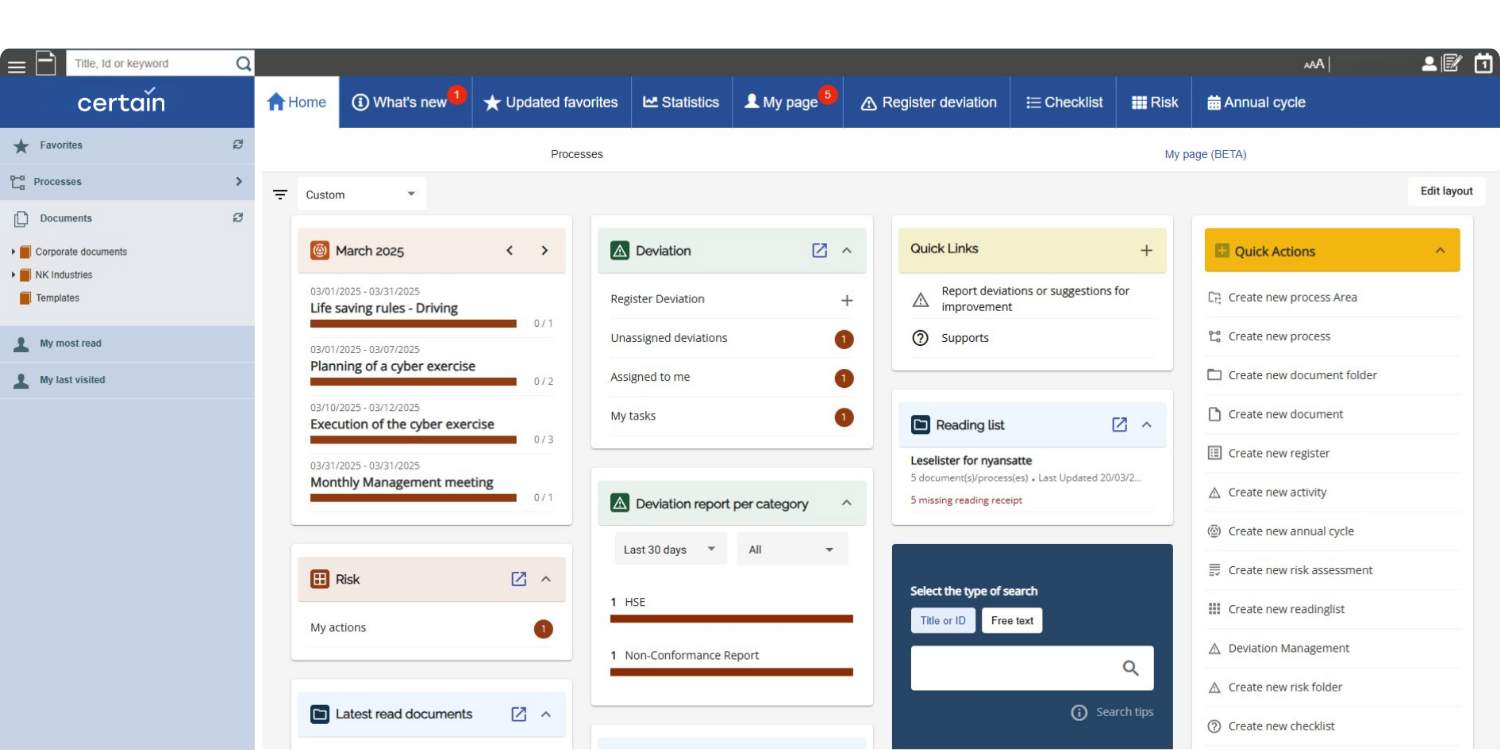
    Example of the Certain QMS homepage.

    From intention to certification

    ISO 9001 is about good habits for management and improvement — and about making it easy to do the right thing. Certain QMS supports this by bringing together processes, documentation, follow-up and improvement in one cohesive solution with clear roles, planned activities and traceable history.

    The result is a quality management system that not only satisfies certification requirements, but also delivers real value in the organisation’s day-to-day operations.

    Marte Sunde

    Marte Sunde

    Business Consultant

    Marte Sunde is a Business Consultant for Certain QMS, specialising in quality management and HSE systems. She works at the intersection of operational practice and digital solutions, helping organisations implement and improve management systems that ensure compliance, structure, and continuous improvement.

    Change management and quality management

    Change management and quality management

    Change management quality

    Most organisations working on change management and quality management introduce new procedures with the best of intentions. The procedures are well thought through, the documentation is in place, and the quality management system is accessible to everyone. Yet nothing changes. People carry on as before. The change quietly dies out, and after a while no one remembers that things were supposed to be different.

    This is not a technical problem. It is a problem of change management in quality management — and it is far more common than most are willing to admit.

    Why change management fails in quality management

    The problem does not start with resistance to change

    It is tempting to explain failed changes through resistance. Employees don’t want to change. They’re used to doing things their way. They don’t understand the importance of the quality management system.

    But resistance is rarely the cause. It is the symptom.

    When people don’t follow new procedures, it is most often because they never understood why the change was introduced. No one explained the connection. No one showed what would actually improve. The change arrived as a top-down directive — a new document in the quality management system, an email saying ‘from Monday, the following applies’ — and then it was up to each individual to find the meaning themselves.

    It is rarely the employees who fail. It is the process surrounding the change that fails.

    When change management stalls between leadership and practice

    Why middle managers are critical in quality management

    One of the most recognisable situations in larger organisations is the change that appears to succeed on the surface, but never quite reaches the front line. Leadership has decided. The quality manager has documented. The system is updated. And then, three months later, people on the floor are still working as before.

    The reason is almost always the same: middle managers were not brought along.

    Middle managers are the link between decision and practice. If they do not understand the change, have not had the time to communicate it, or are themselves uncertain whether it is right, they will not convey it with credibility. And employees follow their immediate manager, not a document in a quality management system.

    John Kotter highlights precisely this in his work on change management: changes do not fail because they are poor, but because organisations skip the critical steps of building buy-in and communicating meaning. A decision is not the same as an implementation. A procedure is not the same as a practice.

    Why documentation alone does not succeed in quality management

    Documentation does not solve a buy-in problem

    Here is an uncomfortable truth for many working in quality management: a well-documented system can actually make the problem worse.

    Once the documentation is in place, it is easy to assume the job is done. The system is updated. The procedure has been approved and published. Employees have access. But that does not mean the system is being used.

    The ADKAR model, developed by Prosci, describes five prerequisites for change to actually happen at the individual level: awareness, desire, knowledge, ability and reinforcement.

    Most organisations focus almost exclusively on knowledge — that is, what employees should do. But if awareness and desire are not in place, knowledge will not lead to changed behaviour. People know what they should do, but do not do it.

    When quality management is experienced as bureaucracy

    Much of the resistance to quality management systems is not about laziness or reluctance. It is about perceived value.

    When employees feel that quality management is primarily there to satisfy the auditor, to document for documentation’s sake, or to protect management, they will respond accordingly. They do what is required — nothing more.

    This is not a problem with the employees. It is a sign that the quality management system is not embedded in everyday working life.

    A quality management system that works in practice is characterised by the fact that it genuinely helps people in their work. The procedures are written for the user. The non-conformity system solves real problems. Management uses the system actively — not only at audit time.

    When employees see that the system works, attitudes shift. Not because they are persuaded, but because they experience value.

    The role of leadership in change management and quality management

    Change management in quality management cannot be delegated away. It is not a project — it is an ongoing leadership responsibility.

    Leaders who succeed in embedding quality management systems do certain things consistently. They use the system themselves. They refer to it in decisions. They follow up on non-conformities and improvements. And they give middle managers both the time and the responsibility to drive the change forward.

    When leadership treats the quality management system as an administrative requirement, the rest of the organisation will do the same. When it is treated as a management tool, the way it is used changes too.

    Change management quality

    What distinguishes successful from unsuccessful change management in practice

    The difference rarely lies in the system — but in how it is introduced and followed up.

    An organisation introduces a new non-conformity system. An email is sent out with a link to the procedure. Two weeks later, three non-conformities have been logged, all from the same department. Six months later, the system has effectively been abandoned.

    Another organisation introduces the same system. Middle managers are involved early. The first non-conformities are followed up promptly. Results are communicated back. Leadership uses the data actively in meetings. After a few months, the system is in use across the organisation.

    The same system. Completely different outcomes. The difference is not the technology or the documentation. The difference is the change management surrounding the quality management.

    Marte Sunde

    Marte Sunde

    Business Consultant

    Marte Sunde is a Business Consultant for Certain QMS, specialising in quality management and HSE systems. She works at the intersection of operational practice and digital solutions, helping organisations implement and improve management systems that ensure compliance, structure, and continuous improvement.

    What auditors actually look for in a management system

    What auditors actually look for in a management system

    Quality Revision Employee

    Many organisations approach an audit feeling well prepared. The documents are in order, the quality management system is up to date, and the last audit went smoothly. Yet some still end up with non-conformities they didn’t anticipate. Others pass — but are left with an uneasy sense of how close it was.

    The reason is often not a lack of documentation. Rather, it is a misunderstanding of what auditors actually look for in a quality management system audit. In other words, an audit is not primarily about whether procedures exist, but whether the system works in practice.

    Three misconceptions about what auditors actually look for in a quality management system

    'We have the procedure — it's in the system'

    This is perhaps the most common one. The organisation has written down its procedures, uploaded them to a system, and considers the job done. But a procedure that sits in a quality management system is not the same as a procedure that is followed in practice.

    An auditor examining non-conformity handling in a quality management system audit does not simply ask whether the procedure exists. They ask who is familiar with it, when it was last used, what happened the last time a non-conformity arose, and whether it was actually handled as the procedure describes. The answer to the first question rarely determines the outcome.

    'The auditor approved us last time — so everything is fine'

    Approval at the previous audit is a snapshot, not a permanent state. ISO 9001, 14001, 45001 and 27001 are all built around the principle of continual improvement. This means that at the next audit, the auditor is not only checking whether you meet the requirements today — but also whether you have followed up on what was identified last time.

    In short, a certification that is not maintained quickly becomes a certification that is not deserved.

    'We're too small for it to matter'

    The standards apply regardless of size. A small organisation may have simpler systems and fewer procedures than a large one — that is entirely legitimate. Nevertheless, the auditor still expects that what exists is actually used and followed up. Size is therefore no excuse for a lack of ownership of your own quality management system.

    What auditors actually examine during an audit

    An audit against ISO 9001, 14001, 45001 or 27001 is not a document review. It is an examination of whether the quality management system works in practice — and whether the organisation truly practises what it preaches.

    Auditors use documentation as a starting point, but what they are really looking for is evidence that the system is in use. This happens through interviews with staff at various levels, review of logs and records, and tracing incidents from start to finish.

    One important point that many underestimate: auditors do not only speak with the quality manager or senior leadership. They may just as easily stop a random employee in the corridor and ask whether they are familiar with the non-conformity procedure, what they would do if they spotted a problem, or who they would report it to. The answers from that employee carry at least as much weight as those from the person who has been preparing for weeks.

    Typical questions that reveal what auditors look for in a quality management system

    • Can you show me a non-conformity that was logged in the last three months — and tell me what happened afterwards?
    • Who is responsible for this procedure, and when was it last reviewed?
    • Have you carried out a management review in the past year — what was decided, and what has been followed up?
    • How do you know that employees are aware of and following this procedure?
    • Can you show me documentation that this risk has been assessed and addressed?

    Notice that none of these questions can be answered with ‘yes, we have a procedure for that’.

    Documentation is evidence — not the goal of a quality management system

    A common misconception is to treat documentation as the primary objective of an audit. It is not. Documentation is evidence that something has been done, decided or assessed.

    A well-written procedure that has never been followed is weaker evidence than a simple routine with clear traces of actual use. Logs, recorded non-conformities, minutes from management reviews and updated risk assessments are what auditors use to judge whether a quality management system is alive.

    This also means that gaps in documentation are rarely the biggest problem. The biggest problem is the gap between what is documented and what actually happens.

    The role of management in an audit

    All four standards place explicit requirements on management engagement. This is not something that can be fully delegated to the quality manager or HSE manager and then forgotten.

    Auditors will typically examine whether management is aware of the organisation’s significant risks and environmental aspects, whether a meaningful management review has been conducted, whether objectives have been set and followed up, and whether resources have genuinely been made available to run the system.

    It is worth highlighting one specific trap that many organisations fall into: the management review is conducted as a brief meeting where the quality manager presents a summary and management nods along. No decisions are made, no actions are documented, and the meeting is forgotten by the following week. For an auditor, this is not a completed management review — it is a meeting that happened to have the right name.

    A quality manager who carries the entire system alone, without genuine management commitment, is a red flag in an audit — regardless of how good the documents are.

    What auditors are not looking for — and what they actually expect from a quality management system

    Auditors are not looking for perfection. But they are not impressed by a system that never records anything either.

    A quality management system with no non-conformities is not a sign that everything is going well — it is a sign that the system is not being used. In practice, auditors want to see a certain volume of recorded non-conformities, ideally spread across different types and departments. This shows that reporting happens systematically rather than sporadically, and that a culture of speaking up genuinely exists within the organisation.

    What auditors view most positively is non-conformities that have been recorded, followed up and closed in a way that demonstrates the organisation has learned something. That is what continual improvement looks like in practice.

    How to prepare your quality management system before an audit

    The organisations that perform best in audits are not necessarily those with the most documentation. They are the ones that can answer questions about what actually happens — and demonstrate it.

    Review your non-conformity and improvement log and make sure that cases have been closed and followed up. Check that documents with a defined review cycle have actually been reviewed. Go through the minutes from your management review and assess whether decisions have been documented and acted upon. Also speak with employees who use the procedures day to day. If they do not know what the procedure says, that is a systemic problem — regardless of how well the document is written.

    Quality Revision QMS system

    Document control as a prerequisite for a functioning quality management system

    Underlying much of what is described here is a fundamental requirement: that the organisation actually knows which documents are current, who is responsible for them, and that they are up to date. Without this, it is difficult to answer an auditor’s questions credibly — even if the underlying practice is sound.

    A system like Certain QMS is built precisely to provide this overview: clear ownership, controlled publishing and traceability that makes it possible to document not only what is current, but how it has developed over time. It is not a guarantee of passing an audit — but it removes one of the most common stumbling blocks.

    An audit is not an exam — it is a conversation

    The best way to approach an audit is not to rehearse answers, but to know your own quality management system well enough to talk about it naturally. Auditors are not out to catch anyone out. They are examining whether the organisation is managed in a way that enables it to deliver on its commitments — to customers, employees, the wider community and society.

    Organisations that understand what auditors actually look for in a quality management system experience audits as useful. Others experience them as threatening. The difference rarely lies in the documents.

    Marte Sunde

    Marte Sunde

    Business Consultant

    Marte Sunde is a Business Consultant for Certain QMS, specialising in quality management and HSE systems. She works at the intersection of operational practice and digital solutions, helping organisations implement and improve management systems that ensure compliance, structure, and continuous improvement.