

An emergency preparedness plan is important, but it provides little value if no one knows how to use it when a critical incident occurs. Many organisations have plans that satisfy the requirements at audits, but which are rarely tested in practice. The result is that preparedness capability becomes weaker than the documentation might suggest.
To build robust emergency preparedness, plans must be part of the organisation’s day-to-day quality work. Employees must know their roles, the organisation must practise regularly, and it must be straightforward to activate the right response when an incident occurs.
Readyware is a new add-on to Certain QMS developed precisely for this purpose. The solution digitises emergency preparedness work and transforms the preparedness plan into an operational tool that can be used both during exercises and in real incidents.
What is Readyware?
Readyware brings together emergency preparedness, continuity planning and the recovery of critical IT systems in one solution. Instead of navigating extensive documents, users gain access to concrete action cards showing what needs to be done, by whom and in which order.
The solution is built on three central areas:
- Acute emergency response when an incident occurs
- Continuity planning to ensure continued operations
- Recovery of IT systems and technical infrastructure
Together, these provide the organisation with support throughout the entire course of an incident, from the initial response until normal operations have been restored.
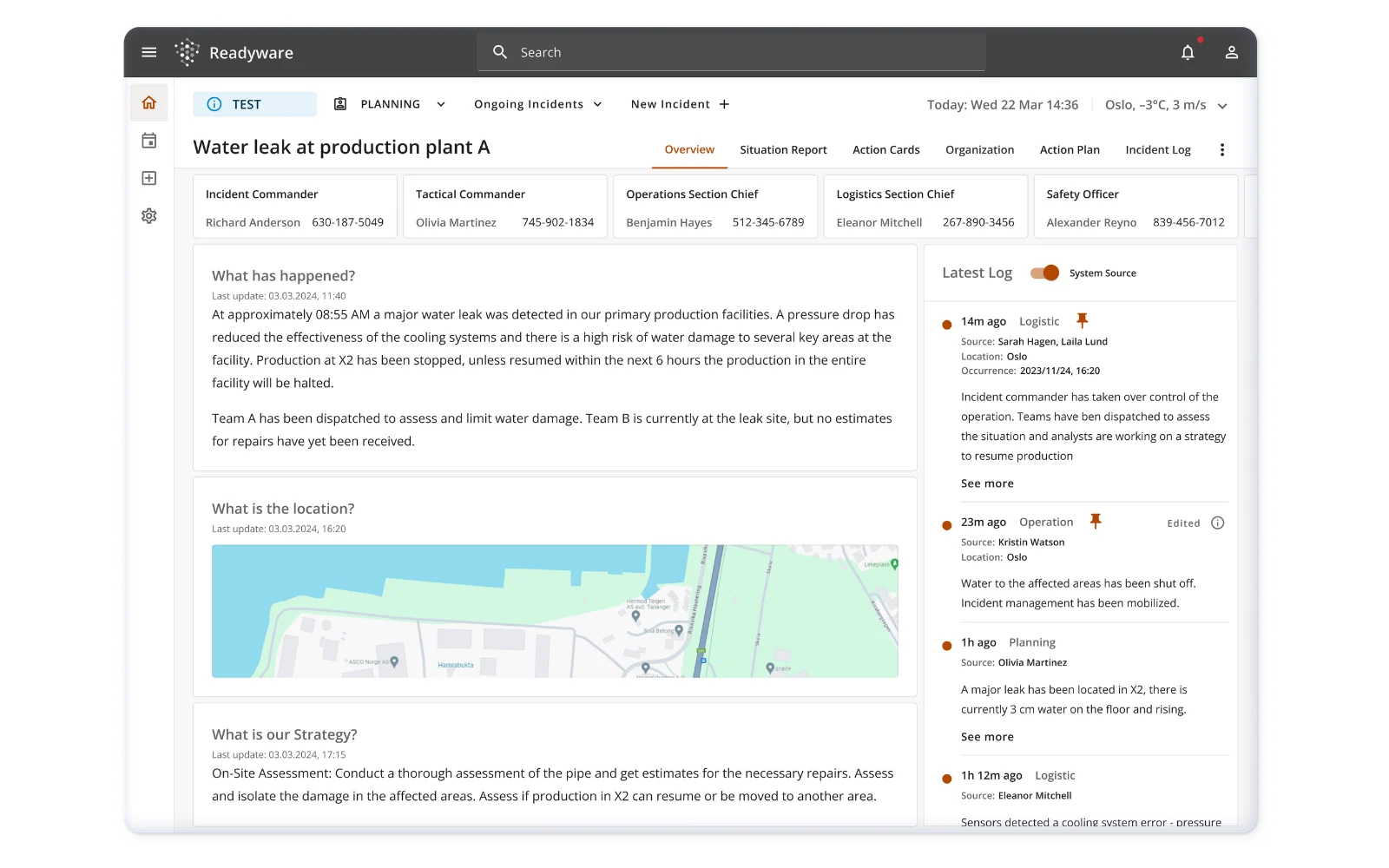
From preparedness plan to practical action
Traditional emergency preparedness plans can run to many pages of procedures. When a critical situation arises, there is rarely time to search for the right information.
Readyware therefore breaks the preparedness plan down into action cards and continuity cards that guide the emergency response team through the incident step by step. The cards can be tailored to the organisation’s own risk assessments and needs.
The solution is delivered with a range of scenarios covering common incidents such as:
- Serious personal injury or fatality
- Fire or explosion
- Mass absence
- Loss of a key person
- Substance-related incidents
- Cyber attacks
- Data breaches
- System failure
Multiple scenarios can be activated simultaneously if the incident develops and affects several parts of the organisation.
Support in all phases of an incident
When an incident is registered, relevant action cards are activated automatically. Actions can be documented continuously with timestamps, giving the organisation a running log of decisions and activities.
Readyware also supports role-based crisis management. Members of the emergency response team gain access to the tasks defined for their role, whilst contact information, notification routines and other key resources are readily accessible.
The solution has been developed with the understanding that critical incidents can also affect the organisation’s own systems. Provision has therefore been made for emergency preparedness work to continue even when the organisation’s ordinary network is unavailable.
Ensuring continuity when it matters
Once the acute phase has been managed, the next challenge is maintaining the organisation’s operations.
Readyware helps the organisation plan how critical functions are to be continued. This includes, amongst other things, prioritising critical systems, evaluating alternative operating modes, managing supplier dependencies and planning the recovery of IT systems in the correct sequence.
This link between emergency preparedness and continuity means the organisation can more quickly reduce the consequences of an incident and return to normal operations.
Simpler and more effective emergency exercises
Regular exercises are an important prerequisite for good emergency preparedness, but many organisations find that exercises require considerable planning and follow-up.
Readyware therefore has a dedicated exercise mode that makes it easier to plan, carry out and evaluate emergency exercises. Exercises can be managed manually or supported by artificial intelligence, which can, amongst other things, function as an exercise director, observer or sparring partner. It is also possible to add new scenarios during the exercise to test how the emergency response team handles complex incidents.
All documentation happens continuously, and the report is generated automatically with timestamped decisions, non-conformities and learning points. This reduces the need for post-exercise work and makes it easier to follow up on improvement actions.
Full overview of emergency preparedness
Readyware brings planning, execution and follow-up together in one dashboard. Here, the organisation can log incidents, initiate exercises, manage emergency response teams, monitor the status of scenarios, evaluate completed exercises and generate reports. The solution can also be linked to relevant legislation, regulations and internal requirements, giving the organisation better oversight of its overall emergency preparedness work.
An emergency preparedness plan is an important starting point, but it only creates value when actively used. By bringing action cards, continuity planning, documentation and exercises together in Certain QMS, Readyware gives the organisation a tool that makes emergency preparedness easier to plan, carry out and improve over time. The result is more operational preparedness and stronger preparedness capability.

Geir Piel
Senior Business Consultant